A modern front door for aviation’s oldest technical pool, built for the engineers who keep fleets flying.
IATP, the International Airlines Technical Pool, has let airlines share spare parts, line maintenance, aircraft-recovery kits, equipment and engines since 1948, and today counts more than 140 member airlines. Its readers are airline technical and procurement people: the engineer arranging cover at an outstation, the AOG desk chasing a part for an aircraft on the ground, the manager weighing whether pooling is worth joining. They arrive with a working question about a service, the network, the next conference or how to join, and a site that reads like a brochure makes them dig for the answer.
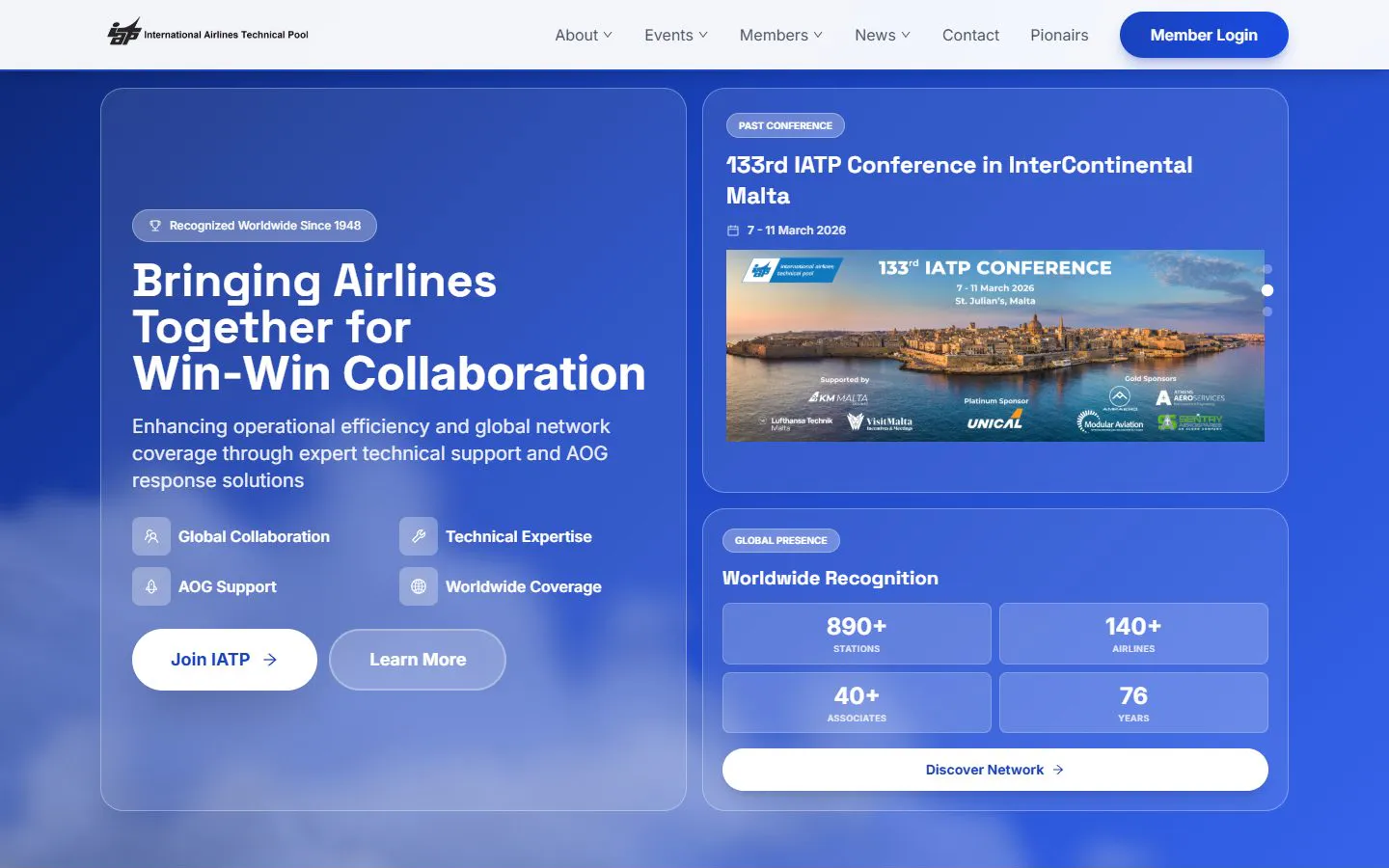
So the redesign answers those questions in the order they come. The five pools lead the homepage as image-backed cards, each saying what it means for a member airline. The size of the network shows as counters for stations, airlines, parts and years. The next semi-annual conference gets a hub of its own with the practical details, and joining splits into clear journeys for airline and associate members, each ending in one call to action.
I redesigned the public website and built the front end, replacing hard-coded styling with a Tailwind token system and one modular JavaScript layer. The live iatp.com runs on the client’s own platform, built from these templates.
Positioning
Industry associations tend to end up with one of two websites: a brochure that says little to someone with a working question, or a members-only wall that shows an outsider nothing. Neither helps an airline decide to join, and neither helps a member in a hurry. The redesign makes the public side do real work.
Services before history
The five pools lead the homepage, each card saying what it means for a member airline, so a technical manager sees the offer before the founding story. Mission, compliance, leadership and history are one tab away on About.
Joining as a journey
Instead of rules buried in a document, the Why Join, Airline and Associate pages walk through eligibility, application and admission step by step, with the member directory beside the rules, so a prospective member sees who is already in.
One place for the next meeting
The next conference sits up front with practical, location and hotel tabs, so attendees stop searching their inboxes for the venue. Past conferences live on as a video playlist for members who couldn’t travel.
A directory that answers
An A–Z filter, search, a live “showing X of Y” count and a marker for suspended members keep the list usable as the pool grows, where a plain list of logos would only get longer.
The result treats an association website as a working tool for technical people: the services, the size of the network, the next meeting and the way in are each one step from the homepage.
Design System
Color
Typography
Tech Stack
Key Features
Pooling, Explained Fast
A visitor should understand pooling in one screen. Image-backed cards for the five pools (parts, line maintenance, aircraft recovery, equipment and engines) each lead to what it means for a member airline.
The Network in Numbers
Scale is the argument for joining a pool. Station, airline, part and year counters count up as they scroll into view.
Conference Hub
The conference is where members meet in person. The next semi-annual conference sits up front with practical, location and hotel tabs, plus an archive of past conferences as a video playlist.
Member Directory
Who else is in the pool is the first thing a prospective member asks. Every member airline is listed with an A–Z filter, search, a live “showing X of Y” count and a status marker for suspended members.
About & FAQ
Due diligence without an email. Tabbed mission, compliance, leadership and history panels and a sixteen-question FAQ accordion answer what an airline’s management will ask before joining.
Membership Journeys
Airlines and suppliers join on different terms. Why Join, Airline and Associate pages walk through eligibility, application and admission, each ending in a clear call to action.