A calm, plain-language library for parents who don’t know what comes next.
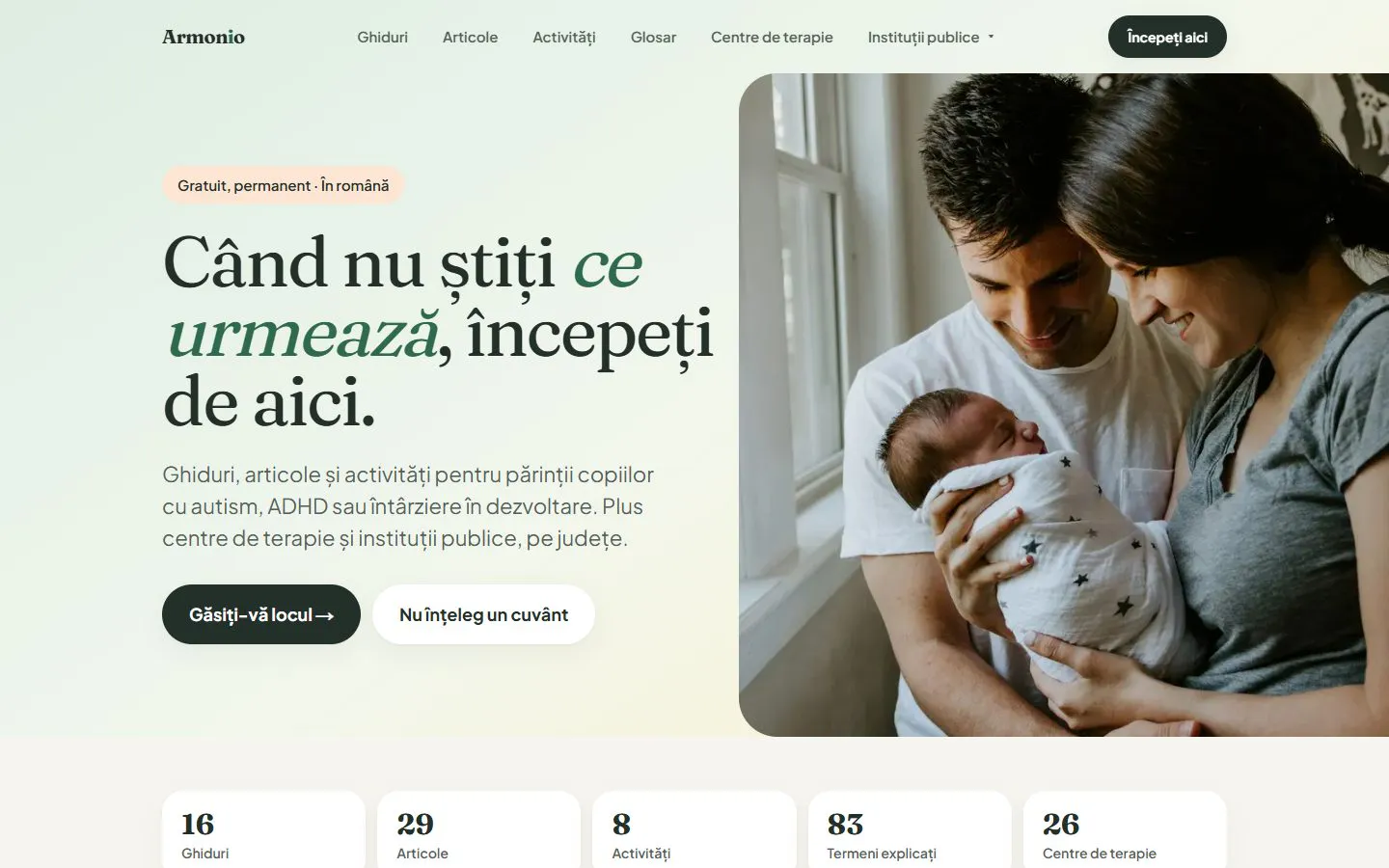
Armonio is a free, Romanian-language library for parents of children with autism, ADHD or developmental delay. Its reader has often just come out of an assessment with a report, a stack of forms and more questions than answers: what the words in the report mean, which rights come with a disability certificate, which office handles what, and who can accompany a child at school. The answers exist, but they are spread across legal texts, institution websites and parent groups, and much of it is written for professionals.
So the library starts from the parent’s situation, not from a menu. The home page asks “Unde sunteți acum?” and offers three journeys (no diagnosis yet, just diagnosed, further along), each a short sequence of steps in the order things actually happen. Every technical term links to a plain-language glossary, and the directories list therapy centres and the public offices families deal with, county by county. The design deliberately avoids the clinical “autism blue”: a warm pastel system, an editorial serif and generous spacing keep heavy topics approachable.
It is public information, free for good. No listing is paid for or promoted, there are no questionnaires that hand out a verdict and no therapeutic claims. Behind it sits a custom CMS, so a new guide goes from markdown to a pre-rendered page without touching code.
Positioning
After a diagnosis, a family usually looks for answers in three places: the legal texts and institution websites that hold the procedures, parent groups where advice is generous but hard to check, and providers whose pages naturally start from their own services. Armonio was designed to sit beside all three as a calm, neutral reference in plain Romanian.
Steps in the order they happen
Three entry points meet a parent where they are. Each journey lays out its steps in sequence, from making sense of the first signs to the evaluation, the certificate and school, so nobody has to work out the order alone.
Words explained where they appear
Reports and decisions are full of terms nobody stops to explain. Every article links them to a plain-language glossary that slides in without leaving the page, and a short block at the end of the article unpacks the rest.
The right office, by county
Directories of therapy centres and of the county child-protection and school-assessment offices filter instantly, even when a name is typed without diacritics. Nothing in them is paid for or promoted.
A reference, not a verdict
No questionnaires that hand out a diagnosis, no therapeutic claims and no forum. The footer says it plainly: nothing here treats or cures anything. It is public information, free and in Romanian.
The result is a place a parent can open on a phone after a hard appointment and leave with the next step, the right office and the words to understand both, without being sold anything.
Design System
Color
Typography
Tech Stack
Key Features
Guided Journeys
A parent starts from their situation, not from a menu: no diagnosis yet, newly diagnosed or further along, each a short sequence of steps in the order things happen.
Glossary Auto-Linking
Jargon is the first wall. Terms are linked automatically inside every article, open in a slide-in glossary sheet and are unpacked again in a block at the end.
Centres & Institutions
Knowing which office handles what is half the paperwork. Directories of therapy centres and of the county child-protection and school-assessment offices filter instantly and ignore diacritics.
Custom CMS
New guides arrive without a developer. A section-based editor stores markdown, with a raw mode, related-content blocks and imports of new content files from the dashboard.
Media Library
Images stay light on a phone. Drop in a whole folder and it is converted to WebP with sharp, ready to bulk-assign as hero images.
Pre-rendered & Tested
Fast on any phone and right every time: over two hundred statically generated pages, seventy unit tests and Playwright end-to-end checks, down to social link previews.