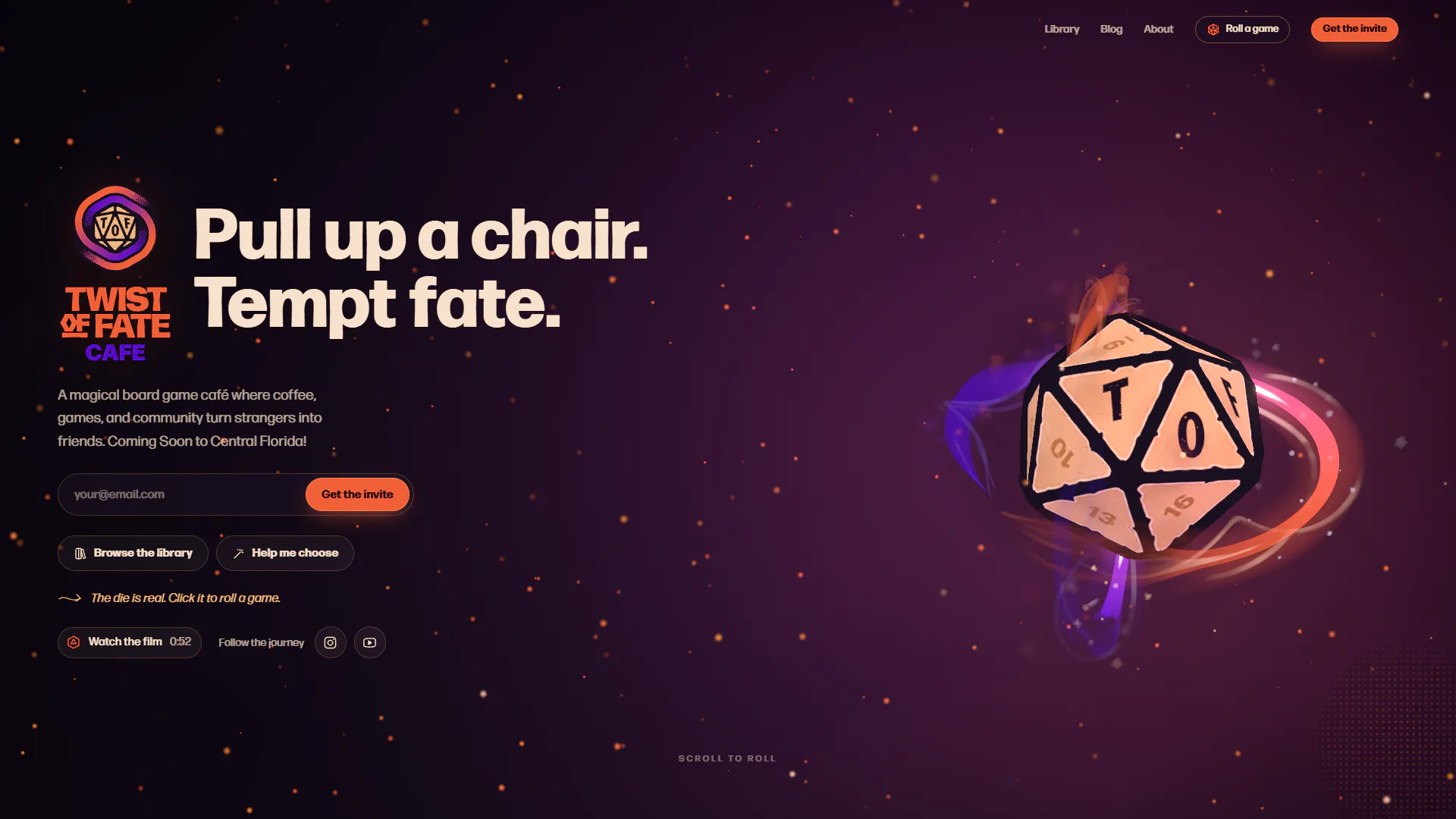
A night at the café, before it opens.
Twist of Fate is a board game café opening in Mount Dora, Central Florida. Many of the people it needs to reach have never set foot in one: they can’t picture the evening, they wonder whether they need to know the rules, and a wall of hundreds of boxes is more daunting than inviting. I designed and built its web platform, live at twistoffatecafe.com since September 2026, to answer that before anyone walks in: a library of more than 450 games with a page for every title, a six-question game finder, a blog, newsletter sign-up and Taste Test ordering for menu nights. Behind it, staff sign in to keep the library current, game data comes from BoardGameGeek and YouTube, every stock change is audited, and retail stock stays in sync with the café’s Shopify store.
The redesign, “The Die Is Cast”, gives the homepage one job while the doors are still closed: make someone who has never been inside feel what a night there is like, and get them on the opening-night list. It is a fantasy tavern at night. One full-screen WebGL scene of fog, drifting embers and a cursor lantern sits behind the whole page, and the logo’s d20 is rebuilt in 3D, cel-shaded with ink outlines and worn edges, while smoke swirls ignite into neon around it. Below come a 3D shelf of real game boxes, a café room the scroll tours table by table, and a 52-second brand film rendered from the same 3D world.
Two directions went to the client, trading cards and a box-art shelf, and the shelf was chosen. The prototype covers the homepage, Library, game pages, Blog and About, was tested on 14 phone sizes, and after a performance pass is usable three times sooner on a throttled mid-range phone. It has not launched yet: twistoffatecafe.com still shows the current design until the redesign is built into the live app.
Brand Film
Positioning
A board game café competes less with other cafés than with a night in, or a restaurant everyone already knows. Its website has to make an unfamiliar evening feel easy, while most hospitality sites are built to list opening hours and a menu. The platform and the redesign were built against that.
A night you can feel from home
Before opening there are no evenings to show yet, so the redesign builds one: fog, lantern light, the die on the table and a camera tour of the room. The opening-night sign-up appears twice along the way, once beside the die and again after the film.
A shelf, not a spreadsheet
Hundreds of game names in a list mean little to a newcomer. The 3D shelf shows real boxes grouped Party, Family, Co-op and Strategy, the box in focus turns its cover to you, and every game has its own page with its complexity, a how-to-play video and the rulebook.
Help choosing, before you arrive
The game finder asks six questions: the first two filter strictly and the other four score the shelf, with ties shuffled so every table gets fresh picks. For a group that can’t agree, Roll a game lets fate pick from what fits.
One library, kept in step
Game details come from BoardGameGeek and YouTube, every stock change leaves an audit entry, and a signed webhook keeps retail stock in step with the café’s Shopify store, so the library online follows the shelves.
The result lets a café that hasn’t opened yet be visited online first: what a night feels like, what is on the shelf and what to play, with a list to join for the first evening.
Design System
Color
Typography
Tech Stack
Key Features
The Die Is Real
A café that isn’t open yet needs one image people remember. The logo’s d20 in 3D, cel-shaded with ink outlines, worn edges and T·O·F on its faces, tilts toward the cursor, its smoke swirls ignite into neon as they turn, and a click rolls it.
A Tavern Behind the Page
Mood is the hardest thing to imagine from outside. One fixed full-screen WebGL scene of layered fog, drifting embers and a lantern glow that follows the cursor sits behind the whole page, with the die moving through it as you scroll.
Pull One Off the Shelf
Players recognise games by their boxes. A 3D shelf of real game boxes, grouped Party, Family, Co-op and Strategy and divided by beech bookmarks with swinging tassels, turns the box in focus to face you, and the arrow keys step along it.
Find Your Table
A first visit is easier when you can picture where you’ll sit. In a cel-shaded café room, scrolling flies the camera from table to table as lamps light one by one and candles flicker, and clicking a table jumps the tour to it.
Fate’s Drawer
For the group that can’t decide: roll the die, or Roll a game in the nav, and titles flick past until fate picks one, filtered by group size, length and complexity if you like.
“What Should We Play?”
The question every table asks gets a six-question wizard: the first two answers filter strictly, the other four score the shelf, and ties are shuffled so every table gets fresh picks. Restyled and reachable from every page.
A Scrollbar of Cards
Even the scrollbar stays in the world: a small wheel of cards on the right edge that turns and flips cards as the page scrolls.
Game Library & Pages
Before picking a game, people want to know how hard it is and how it plays. More than 450 titles with instant search and filters that are remembered between visits, and a page for every game with its complexity, a how-to-play video, a gallery and rulebooks.
Staff Tools & Shopify Sync
A library is only useful if it is accurate. In the live app: server-checked Google sign-in for staff, BoardGameGeek enrichment, inventory changes that always write an audit entry, and a signed Shopify webhook that keeps retail stock in step.
Fast on Every Screen
A first look often starts on a phone. The prototype was tested on 14 phone sizes with a centred safe zone for ultrawide monitors, and a performance pass made the page usable three times sooner on a throttled mid-range phone, with the largest paint in about a second.
Page Architecture
Screenshots
Screens from the redesign prototype. Game box art belongs to its publishers.